Photographing Church Interiors Without a Flash: A Guide for Hampshire’s Historic Churches
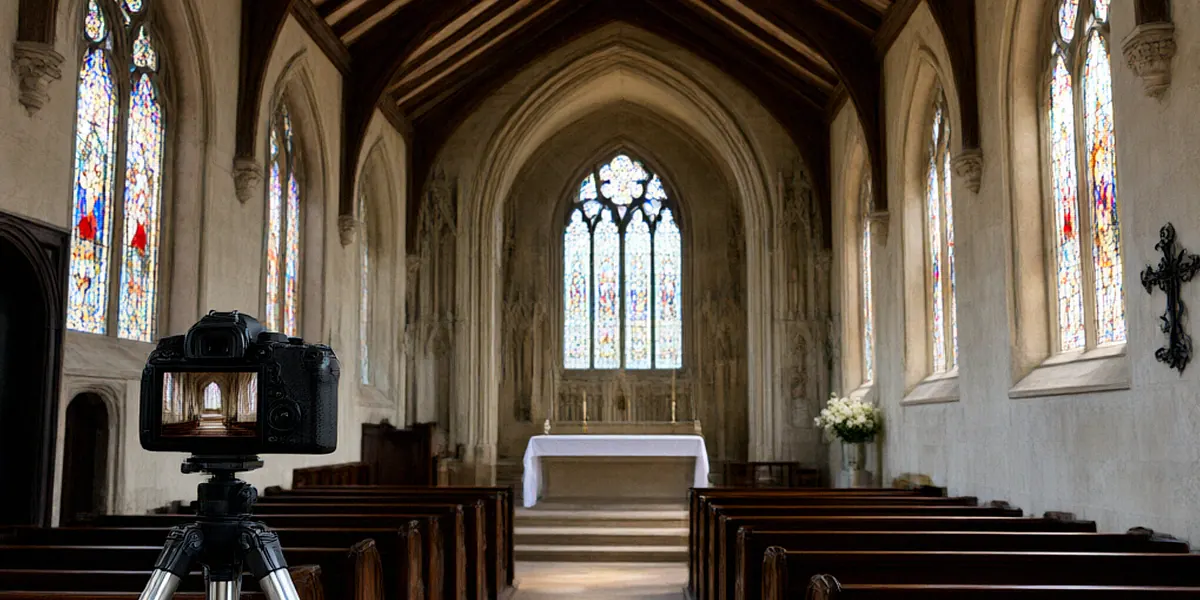
There’s a particular hush inside a Hampshire parish church on a grey Tuesday afternoon. Light falls through stained glass in coloured shafts, medieval wall paintings emerge from shadow, and the air itself seems thicker. Reaching for your flash feels instinctive — and it is almost always the wrong move. Flash can degrade delicate pigments, flatten the atmosphere you came to capture, and disturb anyone quietly praying in a pew. In this guide, we share how our team photographs the interiors of Hampshire churches like Winchester Cathedral and Romsey Abbey using nothing but available light, fast lenses, and patience — the same approach we bring to documenting Romantic piano music performances, from Saint-Saëns piano concertos to Chopin recitals in sacred spaces.
Why Flash Is a No-Go in Historic Churches
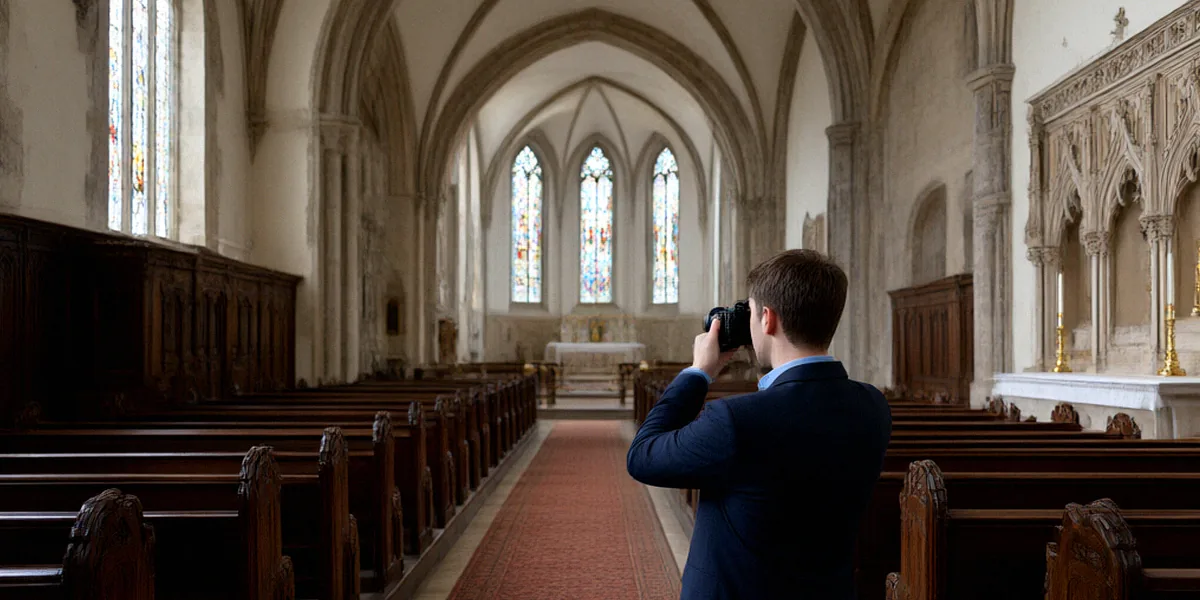
Photography in churches is a privilege, not a right, and flash is the single most common way photographers lose that privilege. The reasons are part conservation, part courtesy.
Conservation Risks to Medieval Wall Paintings
Centuries-old pigments are far more fragile than they look. The medieval wall paintings in St. Cross Hospital, Winchester — among the finest surviving examples in the county — have endured Reformation whitewash, damp, and the slow chemistry of time. Bright, repeated bursts of artificial light accelerate fading and can cause irreversible damage to organic pigments. Conservators treat these surfaces as patients, not backdrops, and our camera settings should reflect that.
Stained Glass and Flash: A Bad Combination
Flash does nothing useful for stained glass. It bounces off the glass surface, kills the transmitted colour that makes windows like those at Romsey Abbey so luminous, and creates harsh reflections. Worse, the heat and UV output of repeated flash exposure adds cumulative stress to leaded glass and its painted details, which are often more delicate than the surrounding glass itself.
Etiquette and Permissions
The Church of England’s ChurchCare guidelines are clear that photography should never disrupt worship or the quiet of a church open for prayer. Practical rules we follow:
- Ask the parish first — permission policies vary hugely between churches.
- Never photograph during a service unless explicitly invited.
- No flash, ever, unless a parish specifically permits it for a documented reason.
- Avoid photographing people without consent, and never photograph children.
- Check whether a fee or photography permit applies — many Hampshire churches rely on visitor donations.
Essential Gear for Low-Light Church Photography
Without flash, your equipment has to work harder. The good news is that modern mirrorless and DSLR systems from Canon, Nikon, and Sony are more than capable of clean results in dim naves.
Choosing a Fast Lens
A fast prime is the single biggest upgrade you can make. Something like a 35mm f/1.4 or a 24mm f/1.8 lets in four to eight times more light than a typical kit zoom. Wider glass also helps you frame sweeping architecture in cramped chapels. We usually carry two primes: a wide for interiors and a short telephoto for details like carved corbels or a single stained-glass panel.
Tripods and Stability
For long exposures, a sturdy tripod is non-negotiable. Churches are full of uneven stone floors and tight corners, so look for a tripod with independent leg angle adjustment and a hook for a weight bag. A remote shutter release or your camera’s two-second timer eliminates the vibration from pressing the button. If tripods are prohibited — as they sometimes are in busy cathedrals — brace your camera against a pew, column, or your own body and use image stabilisation.
Useful Accessories
- A microfibre cloth and blower for dust on sensors (church interiors are dusty).
- A lens hood to cut stray light from side windows.
- Spare batteries — cold stone buildings drain them faster than you expect.
- A small notebook or phone notes app for recording permissions and church names.
Mastering Camera Settings Without Flash
Manual mode gives you the control you need, though aperture priority works well if light levels are stable. Our default approach is to fix the aperture for the depth of field we want, set the ISO as high as we dare, then let shutter speed follow.
Aperture, Shutter Speed, and ISO
For architecture, start around f/5.6 to f/8 for edge-to-edge sharpness. For handheld work, open up to f/1.4–f/2 and accept a shallower plane of focus. Keep shutter speed at or above 1/60s when handheld; drop to several seconds on a tripod. Modern sensors handle ISO 3200–6400 comfortably, but we try not to push beyond the point where noise starts eating detail in dark corners.
Exposure Bracketing and HDR
Church interiors are a classic high-dynamic-range problem: bright windows, dark corners. Bracket three to five frames at one-stop intervals and blend later, or use in-camera HDR as a starting point. When photographing a Romantic piano music performance — say, a Saint-Saëns piano concerto in a church nave — bracket carefully and stay silent; shutter noise is part of the performance, and nobody wants a clatter during a quiet passage.
White Balance for Mixed Lighting
You’ll often be juggling daylight from windows, warm tungsten from a side chapel, and cool LED from a modern lighting rig. Shoot RAW, set white balance to daylight as a baseline, and correct locally in post. Custom white balance from a grey card works well if you have time before the space fills up.
Composition and Storytelling in Sacred Spaces
A church is a story told in stone, glass, and paint. Your job is to find the frames that let that story speak.
Framing Architecture and Details
Use the rule of thirds to place a column or window off-centre, and look for leading lines — aisles, arcades, and roof beams all pull the eye. At St. Cross Hospital in Winchester, the transition from the dark nave into the brightly lit chapel is a natural compositional device. Get low for drama; get high from a gallery if permitted.
Capturing Stained Glass Effectively
Expose for the glass, not the wall. Meter on the brightest part of the window and let the surrounding stone fall into shadow — that contrast is exactly what makes medieval glass sing. Avoid shooting directly into the sun through a window; instead, move sideways so the light comes through at an angle. Romsey Abbey’s windows reward this approach beautifully in late afternoon.
Including People and Atmosphere
A single seated figure can give scale and warmth to an otherwise empty nave. Keep them small in the frame, silhouetted against a window, or blurred with a slow shutter. Never stage a scene in a place of worship; document what is genuinely there.
Post-Processing Tips for Natural-Looking Results
The goal of editing church photography is not to make it look bright and clean — it’s to preserve the atmosphere you felt standing there. The same restraint applies when editing concert photographs of Romantic piano music by composers like Saint-Saëns and Chopin: the mood is the point.
Noise Reduction Techniques
Use Lightroom’s Denoise or DxO PureRAW for high-ISO files; both preserve fine detail better than aggressive in-app sliders. Apply noise reduction before sharpening, and mask sharpening away from flat areas like plaster and stone.
Shadow and Highlight Recovery
Lift shadows gently — a little goes a long way. Pulling too hard reveals sensor noise and flattens the mood. Recover highlights in windows to bring back colour without haloing.
Enhancing Stained Glass Colours
Use selective adjustments on the glass to boost saturation and vibrance slightly. Avoid global saturation, which will turn stone a strange orange. A touch of dehaze can help cut atmospheric haze in large cathedrals.
Ethical and Legal Considerations
Photography in churches sits at the intersection of heritage protection, copyright, and hospitality. Getting it right protects your access and the building itself.
Getting Permission from Parishes
Always contact the parish office before a planned shoot. Many Hampshire churches have a designated fabric officer or churchwarden who can advise on restrictions. ChurchCare provides a helpful baseline, but individual parishes set their own rules.
Copyright and Music Performances
Photographing a concert — including Saint-Saëns piano concertos performed in UK churches — involves both the venue and the performers. You may need permission from the promoter, the musicians, and sometimes the publisher if you’re reproducing sheet music. Never sell or publish concert images without checking rights.
Respecting Worship and Visitors
If a service begins, put the camera down. If someone is praying, give them space. If a verger asks you to move, do so without argument. The building will still be there tomorrow — your reputation might not be.
FAQ
Can I use flash inside a Hampshire church?
Almost never. Flash risks damaging medieval wall paintings and stained glass, and it disrupts worship. ChurchCare guidelines and most individual parishes prohibit it. Ask first, and expect the answer to be no.
What’s the best lens for photographing church interiors without flash?
A fast wide prime such as a 24mm f/1.4 or 35mm f/1.4. It gathers enough light for handheld shooting and lets you frame tall architecture in tight spaces.
Is it legal to photograph a Saint-Saëns piano concerto in a UK church?
The venue’s permission is essential, and you should also check with the performers and promoter. Copyright in the music itself is separate from your right to photograph the performance, so always confirm before publishing or selling images.
How do I avoid noisy images in dark churches?
Use a tripod, keep ISO as low as shutter speed allows, and lean on modern tools like DxO PureRAW or Lightroom Denoise in post. Shooting RAW gives you far more recovery headroom.
Do I need permission to photograph stained glass at Romsey Abbey or Winchester Cathedral?
Yes. Both sites have their own photography policies, and tripods are often restricted during busy periods. Contact the visitor office in advance and respect any conditions they set.
Photographing Hampshire’s church interiors without flash is a discipline — one that rewards patience, good glass, and genuine respect for the buildings. Whether we’re capturing a medieval wall painting at St. Cross Hospital or a hushed Saint-Saëns piano concerto echoing through a nave, the goal is the same: to preserve atmosphere rather than obliterate it. Embrace the dimness. Let the shadows stay. The result will feel far more like the place you stood in.


Post Comment