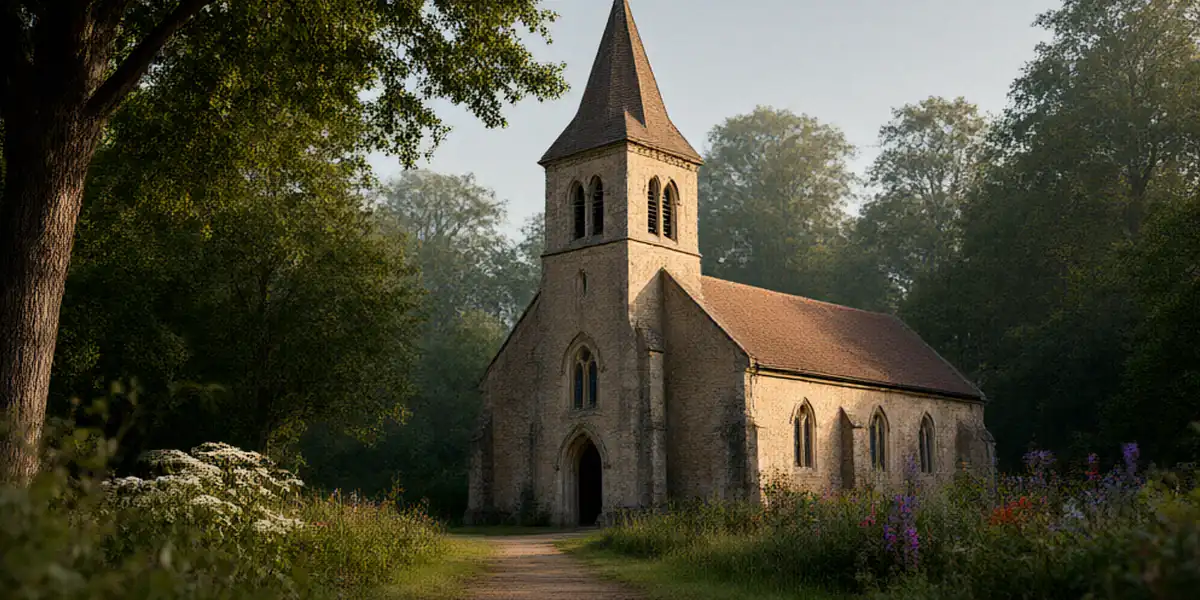
St Nicholas, Freefolk: A Small Church with a Long History
We still remember the first time we pushed open the door at St Nicholas, Freefolk. The church is tiny — you could walk past it without noticing — yet inside, on the north wall, are medieval wall paintings that predate most of the grander churches we have visited across Hampshire. That contrast, between a hamlet church barely larger than a barn and artwork that has survived the Reformation, the Civil War and centuries of damp English weather, is exactly why our team keeps coming back. This page is our guide to Freefolk’s history, its paintings and glass, and the unexpected thread that ties it to the Romantic piano music we love, from Saint-Saëns’s Piano Concerto No. 2 in G minor onwards.
Why St Nicholas, Freefolk Belongs on Every Hampshire Churches List
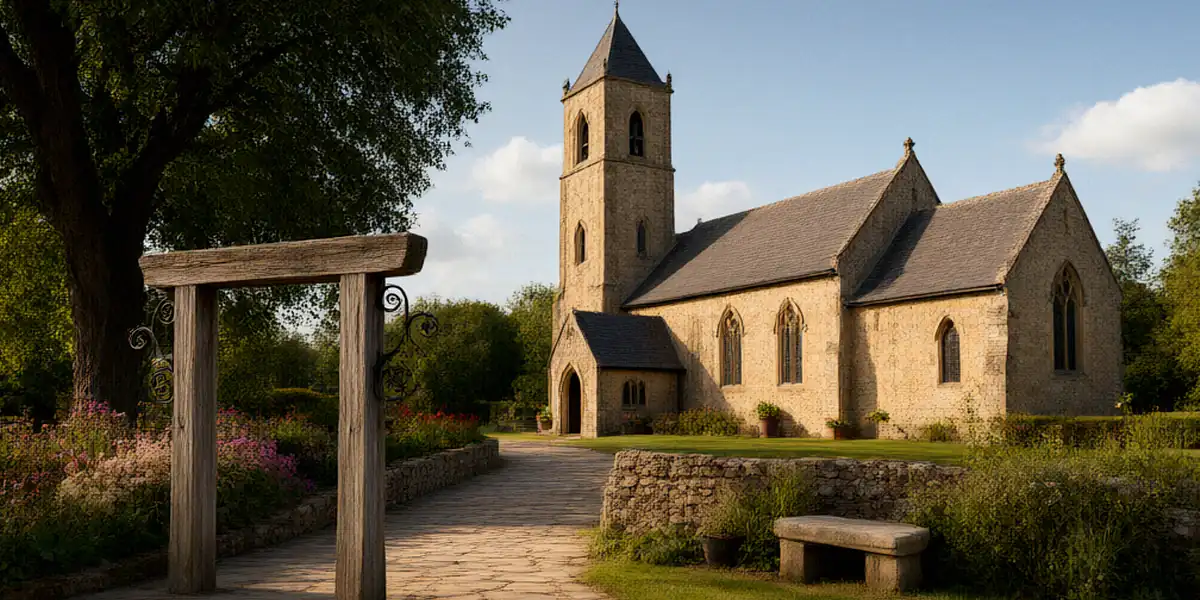
St Nicholas, Freefolk is a small church in the hamlet of Freefolk, near Whitchurch in Hampshire, England. It sits in the Test Valley, a few miles from Overton and Whitchurch, in a landscape of water meadows and chalk streams. The church is dedicated to St Nicholas and stands close to the River Test and the Bombay Sapphire distillery at Laverstoke Mill — an odd pairing on paper, but a genuinely memorable one in person.
A Hamlet Church with a Big Reputation
Freefolk is barely a village: a cluster of houses, a manor, a mill site and the church. That scale is part of the appeal. Because the building is small, its treasures are concentrated. You are not walking down a long nave past thirty monuments; you are standing a few feet from paintings that most visitors to Hampshire churches never see. For anyone building a list of Hampshire churches worth a detour, Freefolk earns its place not through size or spectacle but through rarity.
Getting There: Whitchurch, Overton and the Test Valley
The hamlet lies just off the road between Whitchurch and Overton, with both towns offering the nearest railway stations on the London to Salisbury line. By car, the lanes are narrow and hedged, and the final approach is best taken slowly. We recommend arriving on foot or by bicycle where possible, since the Test Valley lanes are made for it and parking at the church itself is very limited.
The Medieval Wall Paintings That Make Freefolk Special
The medieval wall paintings are the reason we first made the trip. England lost the overwhelming majority of its church wall paintings at the Reformation, when whitewash and changing doctrine buried them, and Hampshire churches preserve very few complete schemes. Freefolk’s survivals are fragmentary but significant, and they reward close, patient looking.
St Christopher and the Christ Child
The best-known image is a rare St Christopher carrying the Christ child. Christopher was the patron saint of travellers, and his image was traditionally placed where it could be seen — often opposite a main door — so that those setting out could ask for protection. At Freefolk, the figure survives as a ghostly outline: enough to read the gesture and the staff, but eroded enough to remind you how close these paintings came to disappearing entirely.
Reading Lost Pigments and Layered Plaster
Alongside St Christopher, there are traces of a larger narrative scheme, often described as parts of a Doom or Passion cycle. What survives is less an image than a record of one: ochre and earth pigments soaked into plaster, plaster that has itself been patched, limewashed and repainted across centuries. When we visit, we look for the edges of figures rather than the figures themselves — the places where a medieval painter’s line disappears under later work.
Conservation Pressures in Small Hampshire Churches
Paintings like these are fragile in ways that are easy to underestimate. Moisture in old walls, the wrong kind of heating, and even well-meaning cleaning can all accelerate decay. Small rural parishes carry the responsibility without the resources of a cathedral, which is why we always encourage visitors to give generously where they can. The churches that survive best are usually the ones with a steady stream of interested visitors and a functioning local fundraising effort.
Stained Glass, Monuments and the Fabric of the Building
The paintings are the headline, but the building itself is a layered document of local power and piety, and we find it just as absorbing.
Fragments of Medieval Stained Glass
The church retains fragments of medieval stained glass, reset and reassembled over time. They are not complete windows in the cathedral manner, but scattered pieces — a face, a fold of drapery, a border pattern — that hint at how colourful the interior once was. For us, these fragments do the same work as the wall paintings: they show a small Hampshire church furnished as richly, in its own way, as a great abbey.
The Hussey Family and Freefolk Priors
The Hussey family of Freefolk Priors are associated with the church and its monuments, and their memorials record a local gentry family’s long connection with the manor and parish. Reading the inscriptions is one of the quiet pleasures of a visit: names, dates and heraldry that tie the building to the wider history of the Test Valley.
Norman and Early English Stonework
The fabric includes thirteenth- and fourteenth-century stonework, with Norman traces and Early English detail in the chancel and openings, topped by a timber roof that gives the interior much of its warmth. It is worth looking up as well as down: the roof structure is often the least photographed and most revealing part of a small medieval church.
From Freefolk to Saint-Saëns: Romantic Piano Music in a Village Setting
Here is the thread that surprises people. We came to Freefolk for the heritage and left thinking about the piano. Standing in that stillness, with the Test running nearby, we found ourselves hearing the opening of Saint-Saëns’s Piano Concerto No. 2 in G minor — the solo piano alone at first, then the orchestra gathering behind it. The scale of the music is the opposite of the building, and that is precisely the point.
Saint-Saëns Piano Concertos and the Romantic Imagination
Saint-Saëns wrote five piano concertos, and the Second, in G minor, is the one that keeps returning to our playlists. Its famous opening — a long, unaccompanied solo that unfolds like an improvisation before the orchestra enters — is one of the great dramatic gestures of Romantic piano music. We also return to the Fourth and Fifth for their clarity and wit. If you are exploring the repertoire, our shortlist is:
- Piano Concerto No. 2 in G minor, Op. 22 — the essential starting point
- Piano Concerto No. 4 in C minor, Op. 44 — structurally ingenious and underrated
- Piano Concerto No. 5 in F major, Op. 103, the “Egyptian” — exotic colour and elegance
- Shorter works such as the Études and the Allegro appassionato for contrast
Listening to Romantic Piano Music After a Church Visit
We like to listen on the drive home, or later the same evening, while the memory of the building is still fresh. The effect is a kind of contrast exercise: the restrained, weathered quiet of Freefolk on one side, the full Romantic orchestra on the other. Somehow each makes the other more vivid, and we notice details in the Saint-Saëns we had previously glossed over.
Why We Pair Heritage and Romantic Repertoire
Both are forms of memory. A medieval wall painting survives because generations chose to keep it, and a Romantic concerto survives because performers and audiences keep choosing to play and hear it. Pairing them is our way of reminding readers that heritage is not only stone and plaster — it is also the music we carry forward.
Visiting St Nicholas, Freefolk: Practical Notes for Our Readers
Before you set out, a few practical points. As with most small Hampshire churches, arrangements can change, so check locally before a long journey.
Opening Times and Access
The church is typically open during daylight hours, and entry is free with donations welcome. Access is via the churchyard path; the building is small, so allow twenty to thirty minutes inside rather than a full afternoon.
Parking, Facilities and Local Refreshments
Parking in the hamlet is very limited, so please park considerately and avoid blocking lanes or gateways. There are no facilities at the church itself. Nearby refreshments are available in Whitchurch or at the Bombay Sapphire distillery at Laverstoke Mill, which makes a natural pairing with a church visit.
Combining Freefolk with Other Hampshire Churches
Freefolk works well as part of a Test Valley day out. We suggest pairing it with other small Hampshire churches in the Whitchurch and Overton area, and finishing with a walk beside the Test. It is a route that suits slow travel rather than box-ticking.
FAQ
Where is St Nicholas, Freefolk?
St Nicholas, Freefolk is a small church in the hamlet of Freefolk, near Whitchurch in Hampshire, England. It stands close to the River Test and the Bombay Sapphire distillery at Laverstoke Mill.
What are the medieval wall paintings at Freefolk?
The church’s medieval wall paintings include a rare St Christopher carrying the Christ child, along with traces of a larger narrative scheme often described as a Doom or Passion cycle. They are among the few such survivals in Hampshire churches.
Is St Nicholas, Freefolk free to visit?
Yes. The church is typically open during daylight hours, and entry is free with donations welcome. Parking in the hamlet is very limited, so please plan accordingly.
Which Saint-Saëns piano concerto should I start with?
Start with the Piano Concerto No. 2 in G minor, Op. 22. Its unaccompanied opening and dramatic orchestral entry make it the most immediate introduction to Saint-Saëns’s Romantic piano writing, and it works beautifully as a contrast to the stillness of a village church.
Who were the Hussey family of Freefolk Priors?
The Hussey family of Freefolk Priors are associated with the church and its monuments, and their memorials record the family’s long connection with the manor and parish.
St Nicholas, Freefolk is a reminder that Hampshire’s smallest churches can carry the deepest histories. A single north wall holds paintings older than most of the county’s grandest buildings, and a hamlet church barely larger than a barn preserves them for anyone willing to make the detour. Visit if you can, listen to Saint-Saëns on the way home, and support these fragile heritage sites — they survive because people keep choosing to care for them.


Post Comment