Church Monuments and Brasses Explained: A Guide to Hampshire’s Parish Churches
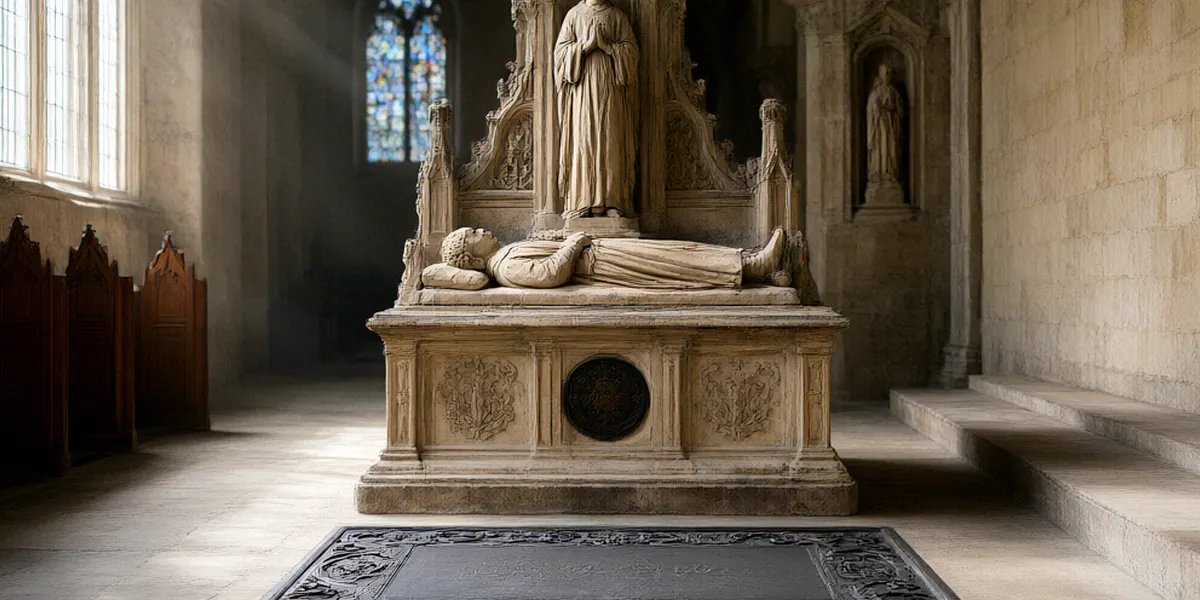
You step into a quiet Hampshire parish church, the door clicks shut behind you, and the silence settles like dust in the afternoon light. Then you look down. The floor beneath your feet is not plain stone at all — it is a ledger stone, its surface worn smooth by centuries of footsteps, its inscription half-erased by time. Once you notice one, you notice them everywhere: on the walls, in the chancel, set into the floor of the nave. Church monuments and brasses are among the most intimate records we have of the people who lived, worshipped and died in these parishes, and Hampshire is unusually rich in them. In this guide, we explain what these memorials are, how to read them, and where to find some of the finest examples in the Test Valley and beyond.
What Are Church Monuments and Brasses?
In the simplest terms, a monument is a three-dimensional memorial — an effigy lying on a tomb chest, a grand wall tablet with a bust or urn, a standing cross or an architectural canopy. A brass is different: it is a flat plate of engraved brass, usually set into the floor or fixed to a wall, with the image and inscription cut into the metal and often filled with coloured enamel or mastic. Hampshire churches contain examples spanning roughly seven centuries, from the 13th to the 20th century, so a single building can hold a whole timeline of local memory.
Monuments Versus Brasses: Key Differences
The distinction matters when you start looking closely. Monuments are sculptural and often monumental in scale — they occupy space, cast shadows and were designed to impress. Brasses are graphic and comparatively modest in size, but they preserve detail that stone rarely does: the exact cut of a sleeve, the links of a mail shirt, the wording of a prayer. Because brass was valuable, many medieval brasses were stripped out at the Reformation, which makes the survivors all the more precious. Where a monument shows you a family’s ambition, a brass often shows you a person.
Why They Matter in Parish Church Architecture
Memorials are not decoration bolted onto a church — they are part of its architecture and its history. They record who paid for a chapel, who held the manor, which families intermarried, and how attitudes to death changed. In parishes with medieval wall paintings and stained glass, monuments and brasses often complete the picture, because the same donors and families frequently appear in all three. Read them together and a Hampshire parish church stops being a pretty old building and becomes a document.
A Short History of Memorials in Hampshire Churches
The story of memorials in Hampshire is really the story of English religion, told in stone and brass. It begins with medieval effigies, shifts sharply at the Reformation, and then loosens into the Baroque and Victorian tablets that still crowd many chancel walls.
Medieval Effigies and Military Figures
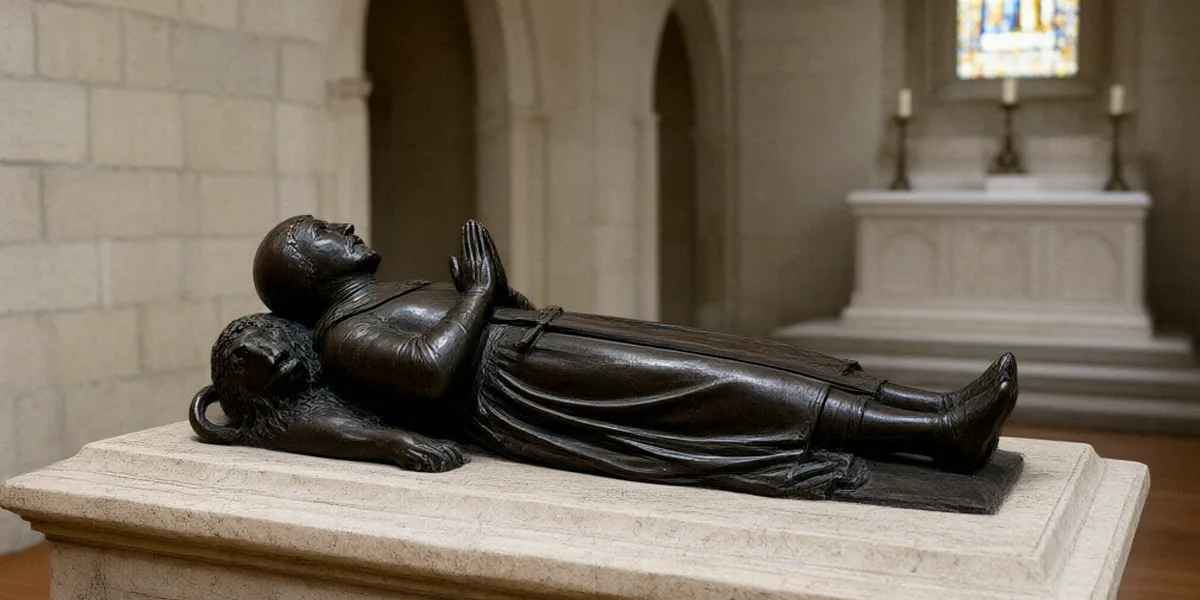
The earliest memorials we see in Hampshire churches are effigies: carved figures, usually recumbent, lying on a tomb chest or set into the floor. Many commemorate knights and gentry, and the classic image is the cross-legged knight, once thought to indicate a crusader, though modern scholars are more cautious about that reading. Armour, shields and swords give us dating clues, and the best examples retain traces of original paint. These figures were intended to lie in perpetual prayer, and in several Test Valley churches they still do.
Reformation and Post-Reformation Brasses
The Reformation of the 16th century swept away much medieval imagery, and thousands of brasses were torn from church floors and sold for scrap. Those that survive in Hampshire often commemorate merchants, lawyers, clergy and minor gentry rather than knights. After the Reformation, inscriptions increasingly appear in English rather than Latin, and the imagery becomes more personal — wives, children and households are named and sometimes shown kneeling in prayer. This is the period when the brass becomes a family record as much as a religious statement.
Victorian and Modern Memorials
By the 18th and 19th centuries, wall tablets in marble and slate dominated. Baroque tablets of the 17th and 18th centuries favour urns, obelisks and weeping figures; Victorian examples are often more restrained, with neat lettering and long lists of names. Memorials from the 20th and 21st centuries are usually simpler again — a plaque, a roll of honour, a small brass in memory of a former vicar. Churches such as St Mary’s, Broughton, and St Peter’s, Stockbridge, show this evolution neatly within a short distance of each other.
How to Read a Monument or Brass
Once you know what to look for, a memorial becomes legible in a way that surprises most first-time visitors. There are four things to examine: costume, heraldry, inscription and symbol.
Costume and Armour Clues
Clothing is the fastest way to date a figure. Mail shirts and surcoats point to the 13th and 14th centuries; plate armour with pauldrons and a sallet suggests the 15th; ruffs and doublets take you into the Elizabethan and Jacobean periods; long wigs and tight breeches place you firmly in the 18th century. Look at the details — belts, buckles, shoes, headdresses — because these are precisely the features that engravers and sculptors recorded from life.
Heraldry and Family Identity
Coats of arms are the shorthand of family identity. A shield on a brass or monument tells you which family the deceased belonged to, and often which families they married into, through impaled or quartered arms. If you can identify the arms, you can usually trace the person in local records. In parishes where the same arms appear on a wall tablet, a brass and a stained glass window, you are looking at a single family’s patronage across generations.
Inscriptions and Symbolism
Inscriptions are the most direct evidence. Earlier ones are in Latin; later ones in English, often with elaborate phrasing listing virtues, offices held and family relationships. Watch for symbols too. Skulls, hourglasses, crossed bones, scythes and extinguished torches are all memento mori motifs, reminding the viewer that life is short. The brasses at St Mary’s, Kings Somborne, reward close reading for exactly this reason: costume, script and symbolism all combine to place their subjects precisely in time.
- Look at the shoes, sleeves and headgear first — costume is the fastest dating tool.
- Sketch or photograph coats of arms, then check them against local heraldic records.
- Read inscriptions slowly and look for hidden lettering on the sides or base.
- Note repeated symbols: skulls and hourglasses almost always indicate a 17th-century date.
Notable Examples in the Test Valley and Beyond
The Test Valley is one of the best places in Hampshire to see memorials in their original settings, and a short drive or walk will take you between several fine examples.
Must-See Brasses in Test Valley Churches
St Mary’s, Broughton, in Test Valley holds a 14th-century brass to Sir John de la Mare — a remarkable survival, and one of the most rewarding brasses in the region. The figure’s armour and the surrounding inscription give a direct link to the medieval gentry who held land here. Combine a visit with St Mary’s, Kings Somborne, whose brasses are equally worth studying, and you can spend a genuinely absorbing afternoon comparing two neighbouring parishes.
Monuments Worth a Detour in Hampshire
St Peter’s, Stockbridge, has a medieval effigy and sits a short walk from the River Test, which makes it an easy and pleasant stop on any church-crawling day. In Andover, St Mary’s holds a collection of wall monuments that illustrate the transition from Baroque to Victorian taste. And no survey of Hampshire memorials is complete without Winchester Cathedral, which contains notable medieval brasses and monuments and is a natural starting point for anyone new to the subject.
Conservation and Etiquette When Visiting
These memorials have survived for centuries, often by luck as much as care, and they remain vulnerable. Brass corrodes, stone erodes, inscriptions fade, and heavy foot traffic wears floors down. Visiting respectfully is not a small matter — it is the difference between these objects surviving another century or not.
Do’s and Don’ts for Visitors
- Do check whether the church is open, and respect any closed areas or roped-off sections.
- Do walk around ledger stones rather than across them where a path allows.
- Do ask before taking photographs, especially with flash.
- Don’t attempt brass rubbing: it is generally not allowed in parish churches without prior permission, because repeated rubbing damages the surface and loosens the fixings.
- Don’t touch incised lettering or lean on monuments and wall tablets.
- Don’t move hassocks, furniture or flowers to get a better view.
How to Help Preserve These Memorials
If you want to do more than visit, there are practical routes. Parish churches usually welcome donations towards fabric and conservation work, and many run friends’ schemes. The Churches Conservation Trust cares for several historic Hampshire churches and relies on volunteers and members to keep them open and maintained. Recording inscriptions and photographing monuments for local history societies is another way to contribute, since a good record can be invaluable if a memorial is later damaged.
FAQ
What is the difference between a church monument and a brass?
A monument is a three-dimensional memorial — an effigy, chest tomb, wall tablet or architectural structure. A brass is a flat engraved metal plate, usually set into the floor or fixed to a wall. Monuments are sculptural; brasses are graphic and often preserve finer detail.
Can I do brass rubbing in a Hampshire parish church?
Generally no. Brass rubbing is not allowed in parish churches without prior permission, because repeated rubbing wears down the engraved surface and can damage the fixings that hold the brass in place. Always ask the incumbent or churchwarden first, and accept a refusal gracefully.
Where can I see a medieval brass in the Test Valley?
St Mary’s, Broughton, in Test Valley holds a 14th-century brass to Sir John de la Mare. St Mary’s, Kings Somborne, is another good option nearby, and the two together make an excellent half-day visit for anyone interested in medieval memorials.
What do skulls and hourglasses on memorials mean?
They are memento mori symbols — reminders of mortality. Skulls, hourglasses, crossed bones, scythes and extinguished torches were common on 17th-century memorials and were intended to prompt the viewer to consider the brevity of life and the state of their own soul.
Which organisation looks after historic Hampshire churches?
The Churches Conservation Trust cares for several historic Hampshire churches, keeping them open and maintained where parishes can no longer support them. Winchester Cathedral also holds notable medieval brasses and monuments, and is a good place to begin if you are new to the subject.
The next time you push open the door of a Hampshire parish church, look down before you look up. The ledger stones under your feet, the brasses set into the floor, the tablets crowding the chancel walls — these are the voices of the people who built and worshipped in these buildings, and they are still speaking. Read them alongside the medieval wall paintings and stained glass, and you will find that they tell the same story: the story of a parish, its families and its faith, written into stone and brass for anyone patient enough to look.

Post Comment