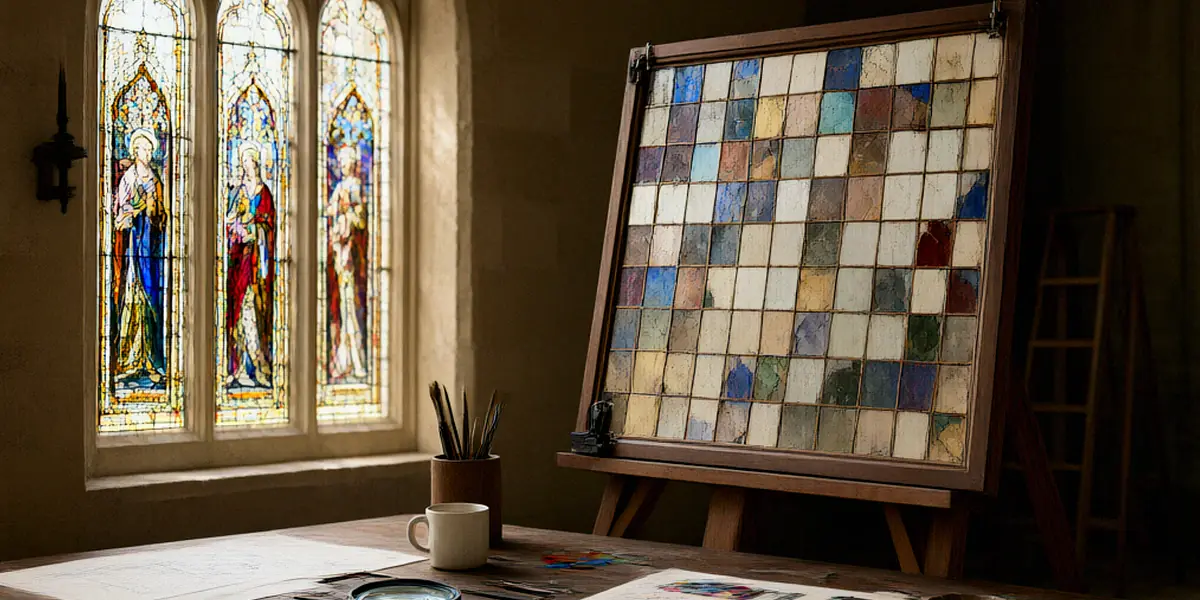
Stained Glass: How to Date a Window
You are standing in a quiet Hampshire parish church, head tilted back, squinting at a stained glass window. The light shifts, the colours glow, and a question forms: is this medieval glass, or a Victorian imitation? It is one of the most common puzzles we hear from visitors to our blog, and it is a genuinely useful one to solve. Dating a window accurately opens up the whole story of a building — who paid for it, which saints the parish honoured, how worship and taste changed across centuries. In this guide we walk through the practical method we use: start with the stone, then read the glass, then confirm with documents.
Why Dating Stained Glass Matters
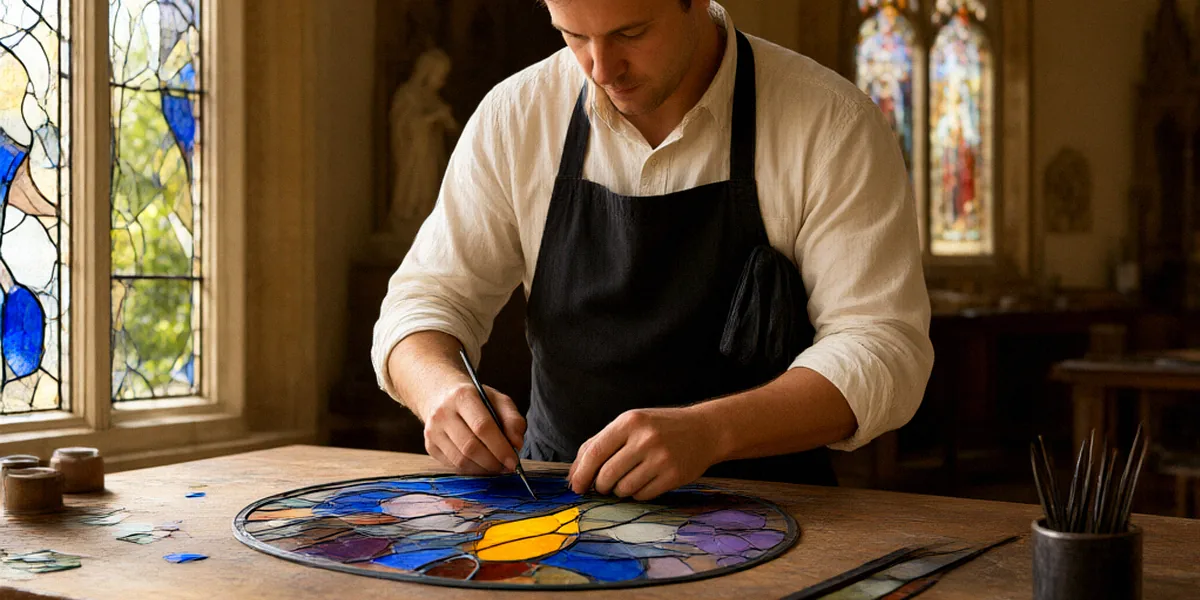
An accurate date turns a window from a pretty object into historical evidence. Hampshire parish churches hold an extraordinary range of glass, from small 12th-century fragments reset in later windows to complete schemes of the 1860s and 20th-century work by firms such as James Powell & Sons. Knowing which is which changes how we read the building.
The difference between medieval and later glass
Medieval glass was made by blowing cylinders or discs, then cutting them into small pieces. The result is glass with bubbles, streaks and irregular thickness. Colour came from metal oxides mixed into the melt, so the palette is limited but intense. Later glass, especially from the 19th century, was often made in larger, more uniform sheets and then heavily painted with enamels to create shading and detail. A medieval figure is usually built from many small pieces of coloured glass; a Victorian figure is often one large piece of pale glass painted brown.
How dating informs conservation and heritage records
Conservation decisions depend on date. Medieval pot-metal glass needs different handling, re-leading intervals and environmental controls from 19th-century enamelled glass, which can flake if moisture sits behind it. Diocese of Winchester faculty records, Historic England listings and our own parish surveys all rely on accurate dates. Get the date wrong and you risk specifying the wrong treatment.
Start with the Building: Architectural Clues
Before you look closely at the glass, look at the hole it sits in. Window openings and tracery are among the most reliable dating tools in a church, and they were usually built before the glass was inserted.
Romanesque, Early English and Decorated tracery
A small, round-headed or deeply splayed lancet points to the Norman or Romanesque period, roughly 1066–1200. A lancet window in a Norman nave at St Mary’s, Twyford, gives you a starting range before you examine a single piece of glass. Narrow pointed lancets grouped in twos and threes belong to the Early English style, roughly 1190–1280. From about 1280 to 1350 we get Decorated tracery: flowing, curving patterns, circles and ogees. The tracery at St Peter’s, Stockbridge, is a good local example of how a Decorated opening narrows the possible date of its glass.
Perpendicular and Tudor window shapes
From roughly 1350 to 1530, Perpendicular tracery dominates: strong vertical mullions, horizontal transoms and large panels of grid-like stonework. These wide windows were designed to flood the nave with light and to hold figure glass in rows. If you see Perpendicular stonework, the original glazing is likely 15th or early 16th century, unless it was replaced later.
Victorian restorations and inserted windows
The 19th century was the great age of church restoration in Hampshire. Architects inserted new windows, widened old ones and refaced walls. A window that looks medieval in shape may have been rebuilt in 1860 and glazed then. Check the external stonework for crisp, uniform tooling and the interior for Victorian brick or tile surrounds.
Reading the Glass Itself: Materials and Techniques
Once the architecture gives you a range, the glass refines it. Four things matter most: colour, thickness, painting method and lead.
Colour palette and pot-metal glass
Medieval glass is pot-metal glass: the colour runs through the whole sheet. Blues are deep and slightly variable, rubies are thin and often flashed, greens vary from olive to emerald. Because each sheet was made separately, colours rarely match perfectly across a window. Uniform, perfectly matched colour across a large area usually signals later manufacture.
Silver stain and enamels
Silver stain, a yellow-orange pigment fired onto the glass, appears in England from about 1300. If you see yellow used on the same piece of glass as another colour, the window is unlikely to predate 1300. Enamel paints, which allow brown, black and later multi-colour painting on one sheet, become common from the 16th century and dominate 19th-century work. Charles Eamer Kempe’s windows are typically heavily painted with enamels over pale glass, giving a softer, more pictorial effect than medieval work.
Lead cames and structural clues
Lead cames hold the glass together. Medieval cames are thick, hand-cast and often milled with a hollow profile. Victorian and modern cames are thinner and more regular. Re-leading happens every century or so, so cames date the repair, not necessarily the glass — but they still help. Look for original glass surviving in the upper lights while lower panels have been replaced.
Style and Iconography: Saints, Stories and Symbols
What is depicted, and how, is often the fastest route to a date.
Medieval saints and medievalism
Medieval windows favour single saints under canopies, with their attributes: St Catherine and her wheel, St Peter with keys, St Michael weighing souls. In Test Valley churches we sometimes find a medieval St Catherine wheel fragment reset into later glass. Be careful: 19th-century designers deliberately copied medieval iconography, so style of drawing matters as much as subject.
Victorian narrative windows and Tractarian influence
From the 1840s, the Oxford Movement encouraged richer liturgy and more elaborate church interiors. Windows became narrative and devotional: the Good Shepherd, the Nativity, the Crucifixion with detailed figures. Clayton & Bell were among the most prolific suppliers to Hampshire parishes, and their work is characterised by clear storytelling, strong outlines and carefully researched costume.
Modern and abstract designs after 1945
Post-war windows often abandon figures for abstraction, using thick slab glass, dalle de verre or bold geometric leading. If a window looks unlike anything medieval or Victorian, check the parish guide — many Hampshire churches installed memorial glass in the 1950s and 1960s.
Makers’ Marks, Inscriptions and Documentary Evidence
Signatures and records can confirm what style suggests.
Known workshops: Kempe, Clayton & Bell, Powell & Sons
- Charles Eamer Kempe: look for a small wheatsheaf, often in a corner panel, and a preference for silvery greens and golds.
- Clayton & Bell: strong narrative figures, rich primary colours, sometimes a small monogram or signature panel.
- James Powell & Sons (Whitefriars): a shield or monogram, and glass of high technical quality with distinctive ruby and blue.
Inscriptions and donor panels
Dated inscriptions are gold dust. A dedication plaque naming a local rector and a year, such as 1864 at St Mary’s, Andover, gives you a fixed point. Donor panels often record a memorial gift, which can be cross-checked against parish magazines.
Using faculty records and church guides
Diocesan faculty records, held at the Hampshire Record Office, list permission to insert or alter windows. Parish guides, vestry minutes and local newspaper archives fill in the rest. Always cross-check a maker’s mark against a document before committing to a date.
Case Study: A Window in Test Valley
Here is how the method works in practice, using a composite example based on a window at St Peter’s, Stockbridge.
Initial observations in the church
The opening has Decorated tracery with flowing ogees, suggesting a 14th-century origin. The glass, however, shows uniform pale sheets with heavy brown enamel painting, a Good Shepherd figure and two kneeling donors. Colours are matched across panels, and the lead cames are thin and regular. These features point away from the Middle Ages and towards the 19th century.
Cross-checking with records
A small wheatsheaf appears in the lower right panel — the mark of Charles Eamer Kempe. A faculty record dated 1873 grants permission to reglaze the chancel window as a memorial. The style, the mark and the document agree.
What the date tells us about the parish
An 1870s date places the window in the great era of Victorian restoration in Test Valley. It tells us the parish invested in high-quality work from a leading workshop, that a local family funded a memorial, and that the medieval tracery was retained rather than replaced — a common compromise that preserves the building’s older bones.
Frequently Asked Questions
Can I date a window from a photograph alone?
Sometimes, but not reliably. Photographs hide glass thickness, bubbles, lead profiles and small maker’s marks. We always recommend an in-person look, ideally with binoculars and a torch held at an angle to reveal painting texture.
Is all old-looking glass in Hampshire churches medieval?
No. Much of what looks medieval is 19th-century work by firms such as Clayton & Bell or Charles Eamer Kempe, made deliberately in a medieval style. Genuine medieval glass in Hampshire parish churches often survives only in fragments reset into later windows.
Where are faculty records kept?
For Hampshire, most faculty records are held at the Hampshire Record Office in Winchester, with some material at the diocesan office. Parish guides and vestry minutes are usually kept in the church or with the incumbent.
Does re-leading change a window’s date?
No. Re-leading replaces the lead cames but leaves the glass. A window re-led in 1950 may still contain 15th-century glass. Use cames as a clue to repair history, not to the original date of the glass.
How can I share a discovery with you?
Send us photographs, the church name, the window location and any inscription details. We welcome contributions from readers across Hampshire and the Test Valley, and we credit discoveries in our parish church features.
Dating a stained glass window is a skill built from small observations: the shape of the tracery, the colour of the glass, the weight of the lead, the mark of a maker. Next time you visit a Hampshire parish church, take a few minutes to look properly. Start with the stone, move to the glass, and check the records. If you find something interesting — a Kempe wheatsheaf, a Powell shield, a medieval fragment hiding in a Victorian panel — we would love to hear about it.

Post Comment