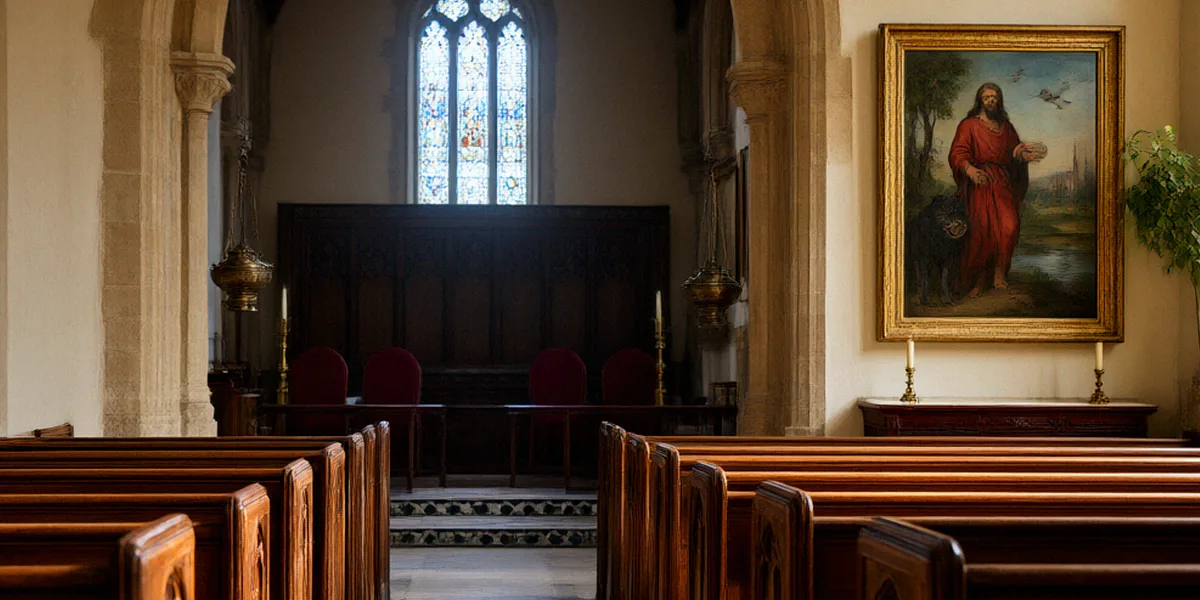
St Mary’s, Tufton: The St Christopher Painting
We still remember the first time we pushed open the door of St Mary’s, Tufton. The latch gave with a soft click, the cool air of the nave met us, and there, on the north wall, was the quiet gaze of a medieval giant: St Christopher, staff in hand, wading through a painted river with the Christ Child on his shoulder. It is one of those moments that reminds us why we spend our weekends hunting down Hampshire churches — the sense that a village church can hold centuries of devotion in a single, faded image.
The Church of St Mary, Tufton: A Hidden Test Valley Gem
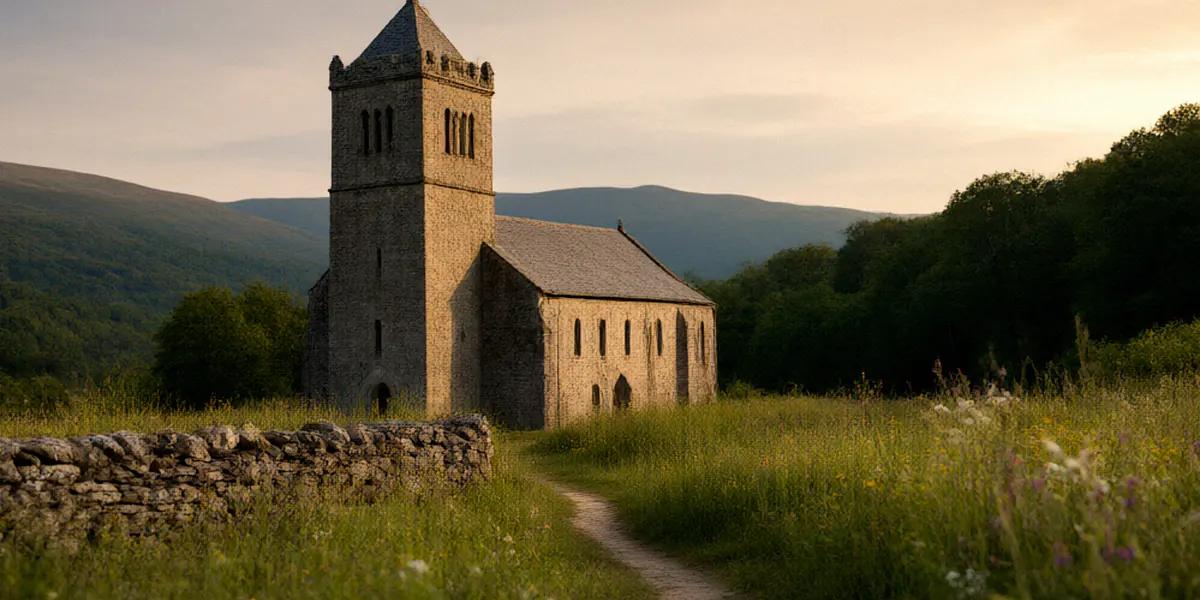
St Mary’s, Tufton is a small medieval parish church in the Test Valley, Hampshire, sitting quietly near Whitchurch in a landscape of watercress beds, chalk streams and narrow lanes. It is not a grand building, and that is precisely its charm. What you find here is a simple two-cell church — nave and chancel — topped by a weatherboarded bell turret, all under a modest roof and surrounded by a churchyard that feels untouched by the modern world.
Location and Setting in the Test Valley
Tufton itself is little more than a hamlet, and the church stands at the end of a lane with fields pressing in on either side. The River Test, one of England’s finest chalk streams, runs nearby, and the whole area is characterised by that soft, watery Hampshire light that seems to suit old wall paintings. For anyone exploring the Test Valley’s churches, Tufton makes an easy pairing with Whitchurch, Hurstbourne Priors and the villages strung along the valley.
Architecture and Building History
The fabric of St Mary’s is mostly 12th and 13th century, with the nave and chancel reflecting the standard medieval parish plan. The dedication to St Mary places it within the most common category of English church dedications. Later additions are minimal, which is part of why the interior retains such a strong medieval atmosphere. The weatherboarded bell turret is a particularly Hampshire feature — timber-framed, clad in boards, and far more humble than a stone tower, it speaks of a small rural congregation rather than a wealthy monastic patron.
The St Christopher Wall Painting: Discovery and Survival
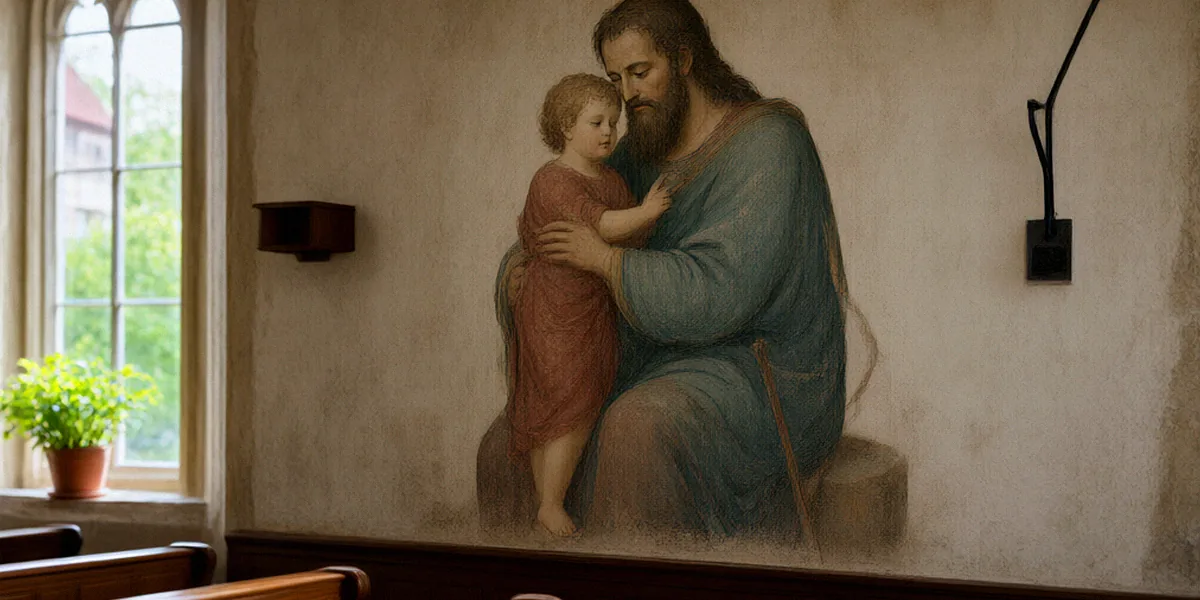
The star of St Mary’s, at least for us, is the St Christopher wall painting on the north wall of the nave. It is a substantial figure — Christopher dominates the wall — and it was rediscovered under layers of limewash, the white coating that was applied to church interiors after the Reformation to cover over what were considered superstitious images. The painting’s survival is something of a minor miracle, and its condition, while worn, still allows the main outlines of the figure and the Christ Child to be read.
How the Painting Was Rediscovered
Like many medieval wall paintings in Hampshire churches, the Tufton St Christopher was brought back to light during 19th or 20th century restoration work. When the limewash was carefully removed, the ghostly figure emerged: the saint’s face, the staff, the child, and fragments of the surrounding composition. The paint is now fragmentary, with areas where the plaster has lost its pigment entirely, but the essential iconography survives.
Why St Christopher Was Painted in Parish Churches
St Christopher was one of the most popular saints of the medieval period, and he was invoked especially by travellers. The convention was to paint him on the north wall, facing the south door, so that anyone entering the church would meet his gaze and could ask for his protection on the road. In an age when pilgrimage and travel were dangerous, this was a practical, everyday devotion rather than an abstract theological statement. The fact that Tufton’s painting sits on the north wall of the nave fits this pattern exactly.
Reading the Iconography: St Christopher and the Christ Child
To read a St Christopher painting is to read a whole medieval world view in a single image. The standard composition shows the saint wading across a river, leaning on a staff, with the Christ Child on his shoulder. The child is often shown holding an orb — the world — and sometimes a cross. Around the figure there may be a hermit with a lantern on the bank, fish in the water, and occasionally a mermaid, a symbol of temptation or of the dangers of the sea.
The Saint and the River
The legend tells of a giant named Reprobus who sought to serve the greatest master and was directed to carry travellers across a dangerous river. One night he carried a child who grew heavier and heavier, until the child revealed himself as Christ and the weight was the weight of the world. Christopher means “Christ-bearer”, and that is the theological heart of the image: the saint literally carries Christ, and by extension the viewer is invited to do the same.
Details and Symbols in the Tufton Painting
At Tufton, we can still make out the essential elements: the saint’s staff, the child on his shoulder, and traces of the river. Inscriptions or scrolls often accompanied these paintings, sometimes with the words “Qui me portat portat Christum” or a vernacular warning. Even where the text is lost, the visual grammar remains legible to anyone who knows the legend.
Medieval Wall Paintings in Hampshire Churches: Context and Comparison
Tufton is not alone. Hampshire once bristled with painted churches, and a surprising number of medieval wall paintings survive in the county’s parish churches. St Mary’s, Breamore, near Fordingbridge, is famous for its Anglo-Saxon rood and its painted schemes; St John the Baptist, Upper Eldon, preserves important medieval wall paintings in a small rural setting. Together with Tufton, these churches give us a sense of how richly decorated medieval worship spaces once were.
Why So Few Medieval Paintings Survive
The Reformation and subsequent whitewashing led to the loss of most medieval wall paintings in Hampshire churches. Images of saints were considered idolatrous, and the simplest solution was to cover them with limewash. In many churches the paintings were destroyed outright; in others they were simply hidden, and centuries later restorers peeled back the white to reveal them. Damp, roof leaks and well-meaning Victorian restorations have done the rest.
Other Hampshire Churches with Wall Paintings
If the Tufton St Christopher whets your appetite, these are worth seeking out:
- St Mary’s, Breamore — Anglo-Saxon fabric and important medieval paint schemes.
- St John the Baptist, Upper Eldon — a small church with significant medieval wall paintings.
- St Mary’s, Tufton — the St Christopher on the north wall of the nave.
Visiting St Mary’s, Tufton: What to Look For
St Mary’s is a working parish church, and like most rural Hampshire churches it is usually open during daylight hours, though it is always worth checking locally before making a special journey. When you visit, please remember that this is a place of worship first and a heritage site second.
Practical Information and Access
Bring binoculars if you want to study the upper parts of the St Christopher painting, and a torch can help in the darker corners. The church is in the Test Valley near Whitchurch, so it combines well with a walk along the Test or a visit to nearby villages such as Hurstbourne Priors and Longparish.
Other Features of Interest in the Church
Beyond the wall painting, look for the font, which is often the oldest object in a medieval church, and any surviving stained glass, which in a small church like Tufton is usually fragmentary but telling. The roof timbers are also worth a glance — vernacular carpentry often reveals more about a building’s history than the stonework.
Preservation and the Future of Tufton’s St Christopher
Wall paintings are among the most fragile objects in any church. Humidity, light, and previous interventions — including the limewash itself — all affect their condition. The Tufton St Christopher has survived because the plaster held and because the covering protected it, but that survival is not guaranteed forever.
Conservation Challenges
Conservators working on medieval wall paintings must balance stabilisation with reversibility. Too much heat or moisture can lift pigment; direct sunlight fades what remains. Where the Churches Conservation Trust or local volunteers are involved, the priority is usually to keep the building weathertight and the environment stable, which does more for the painting than any dramatic intervention.
How to Support Hampshire’s Parish Churches
You can help by visiting, by donating at the door, by joining a local friends’ group, or by supporting the national bodies that care for redundant churches. Every visitor who pushes open a church door and takes an interest is part of the chain of care that keeps these buildings alive.
FAQ
Where is St Mary’s, Tufton?
St Mary’s, Tufton is a small medieval parish church in the Test Valley, Hampshire, near Whitchurch. It sits in a rural hamlet setting close to the River Test.
What is the St Christopher painting at Tufton?
It is a medieval wall painting on the north wall of the nave, showing St Christopher carrying the Christ Child across a river. It was rediscovered under limewash during restoration work.
Why was St Christopher painted opposite the south door?
St Christopher was invoked by travellers, and the convention was to place his image where people entering the church would see it, so they could ask for protection on their journey.
Are there other Hampshire churches with medieval wall paintings?
Yes. St Mary’s, Breamore and St John the Baptist, Upper Eldon are among the Hampshire churches with surviving medieval wall paintings, alongside Tufton.
Can I visit St Mary’s, Tufton?
The church is usually open during daylight hours, but it is always best to check locally before travelling. Please respect the building as a place of worship and bring binoculars to see the painting’s details.
St Christopher at Tufton has watched over this small corner of the Test Valley for centuries, surviving the Reformation, whitewash and neglect. He is a quiet witness to generations of travellers and parishioners, and a reminder that the most remarkable treasures in Hampshire churches are often the least celebrated. We urge you to seek out Tufton and its fellow painted churches while these fragile images can still be seen.

Post Comment