Reading a Parish Church: A Beginner’s Guide
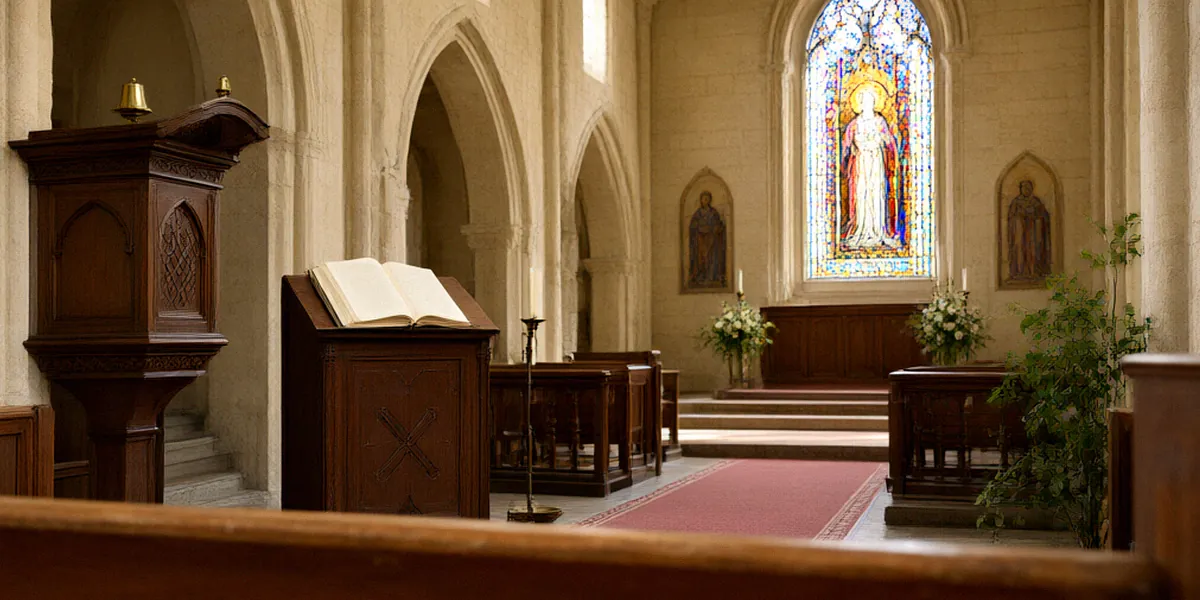
You push open the heavy oak door of a quiet Hampshire church and step inside. The air is cool, faintly scented with old wood and stone. Light falls through coloured glass onto worn flagstones, and everywhere you look there are carvings, monuments, painted panels and arches layered one upon another. It can feel overwhelming — as though the building is speaking a language you never learned. Here is the good news: it is a language anyone can pick up. With a handful of skills, you can begin to read the stories hidden in stone, glass and paint, and every church you visit afterwards will reward you for it.
Why Learn to Read a Parish Church?
Hampshire is extraordinarily rich in church heritage. The county has over 300 medieval churches, ranging from tiny Norman chapels in isolated hamlets to the great abbey church at Romsey. Each one preserves traces of the people who built, decorated, altered and repaired it across nearly a thousand years. Learning to read these buildings connects us directly to local history — not the history of kings and battles, but of ordinary parishioners, masons, glaziers and painters.
The Spiritual and Historical Layers
A parish church is never a single statement. It is a conversation across centuries. A Saxon doorway may sit beneath a Norman tower, which in turn supports a Perpendicular window inserted when a local wool merchant paid for modernisation. Wall paintings were whitewashed at the Reformation and rediscovered by Victorian restorers. Each layer tells us what a community believed, feared and valued at a particular moment. When we learn to read those layers, we are reading the spiritual biography of a place.
Hampshire’s Unique Church Heritage
Few counties can match Hampshire’s range. The Test Valley in particular is a superb area for church crawling, with a dense cluster of medieval churches set in villages along the river — Stockbridge, Houghton, Broughton, King’s Somborne and many more. Because the region was prosperous but not industrialised, many churches escaped heavy Victorian rebuilding and retain medieval fabric, glass and paint that elsewhere was lost. If you are new to church crawling, the Test Valley is the place to start.
Start with the Architecture: A Chronological Framework
Architecture gives us our first framework for dating what we see. English church architecture moves through recognisable phases, and once you can identify a few key features, you can begin to place any church in time.
Saxon and Norman: Round Arches and Thick Walls
Saxon work, roughly pre-1066, is the hardest to spot. Look for tall, narrow openings, long-and-short quoins at corners, and simple, heavy forms. St Mary’s, Breamore, is one of the finest surviving Saxon churches in England and features a rare Saxon inscription above its south doorway, along with a Saxon rood — a carved figure of Christ on the cross — set into the wall. After the Norman Conquest, building exploded. Norman churches are recognisable by their massive walls, small windows and, above all, round arches. A Norman doorway, often richly carved with chevrons or beakheads, is the classic giveaway. Romsey Abbey is a masterpiece of Norman architecture, and its famous crucifixion relief is among the finest Romanesque sculptures in the country.
Gothic Styles: Pointed Arches and Tracery
From the late twelfth century, the pointed arch arrived. Early English work (roughly 1190–1300) is slender and elegant, with tall lancet windows and little decoration. The Decorated style that followed (c.1300–1350) is more ornate, with flowing tracery, ogee curves and elaborate carving. When you see a window filled with intricate stone patterns rather than simple openings, you are likely looking at Decorated work.
Perpendicular: The Vertical Emphasis
From around 1350 to the Reformation, English masons developed the Perpendicular style — so called because of its strong vertical lines. Look for large windows divided by thin vertical mullions and horizontal transoms, creating a grid-like effect. Tower openings, panelled walls and fan vaults all belong to this period. Perpendicular windows flood interiors with light, and they are the single easiest feature for a beginner to identify.
Decoding Medieval Wall Paintings
Before the Reformation, the interiors of most parish churches were brightly painted. Scenes from scripture, saints’ lives and moral lessons covered the walls, teaching an often illiterate congregation through images. Most were whitewashed over in the sixteenth century, but many survive beneath the lime, and conservators continue to reveal them.
Where to Look: Chancel, Nave, and Font
Paintings tend to survive in specific places. The chancel arch often carried a Doom — a depiction of the Last Judgement. The nave walls might show saints or moral allegories. Fonts were frequently painted, and you may find traces of colour on the stone. Look at the areas above arches, beside doorways and in window reveals, where whitewash was applied thinly or has since flaked away. Faint outlines and ghostly red ochre lines are often the first clue.
Common Subjects and Their Meanings
Certain subjects appear again and again, and knowing them helps you interpret what you find:
- The Doom — Christ in judgement, with the saved ascending and the damned dragged to hell. Designed to encourage repentance.
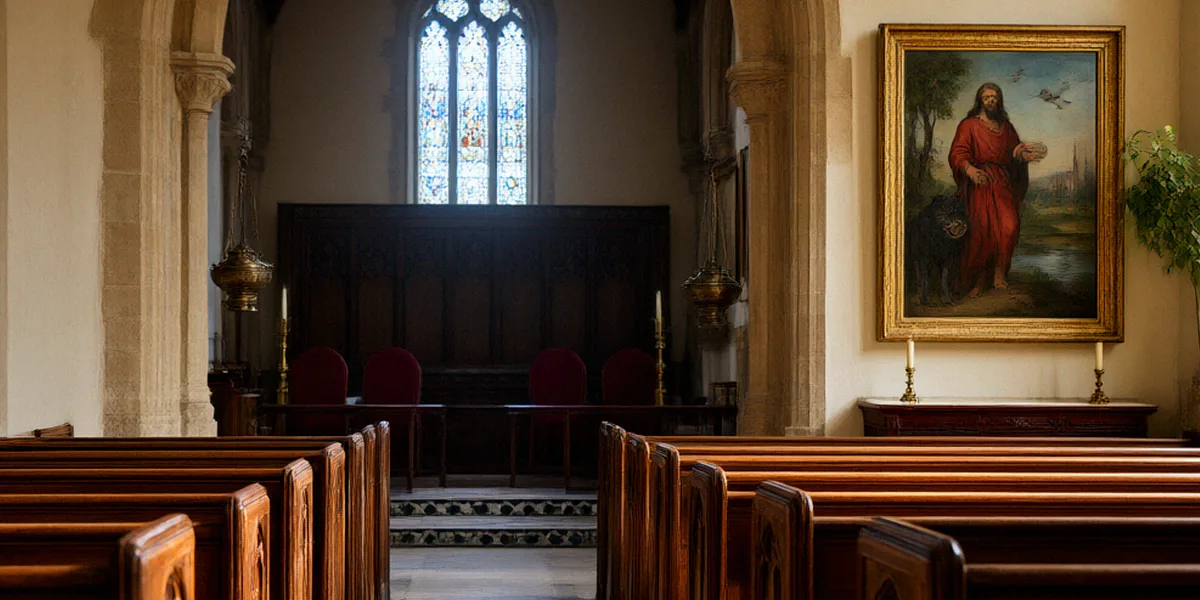
- St Christopher — the giant carrying the Christ child across a river. Believed to protect those who saw it from sudden death that day.
- The Seven Deadly Sins — often shown as a wheel or tree, with each sin personified.
- The Three Living and the Three Dead — a warning that death comes to all, regardless of wealth.
- St George and the Dragon — popular devotion and local pride.
Conservation and Discovery
Hampshire has notable survivals. St Mary’s, Ashley, has significant medieval wall paintings including a Doom scene, and is well worth a visit for anyone interested in this subject. Similar schemes have been recorded at St Mary’s, Hardmead, and St John the Baptist, Upper Eldon. Conservation is delicate work: removing later limewash can damage what lies beneath, so paintings are often left partially exposed, revealing just enough to tantalise.
Understanding Stained Glass: More Than Pretty Colours
Stained glass is the most immediately beautiful feature of many churches, but it is also a text to be read. Every figure, colour and gesture carries meaning.
Medieval Glass: Stories in Light
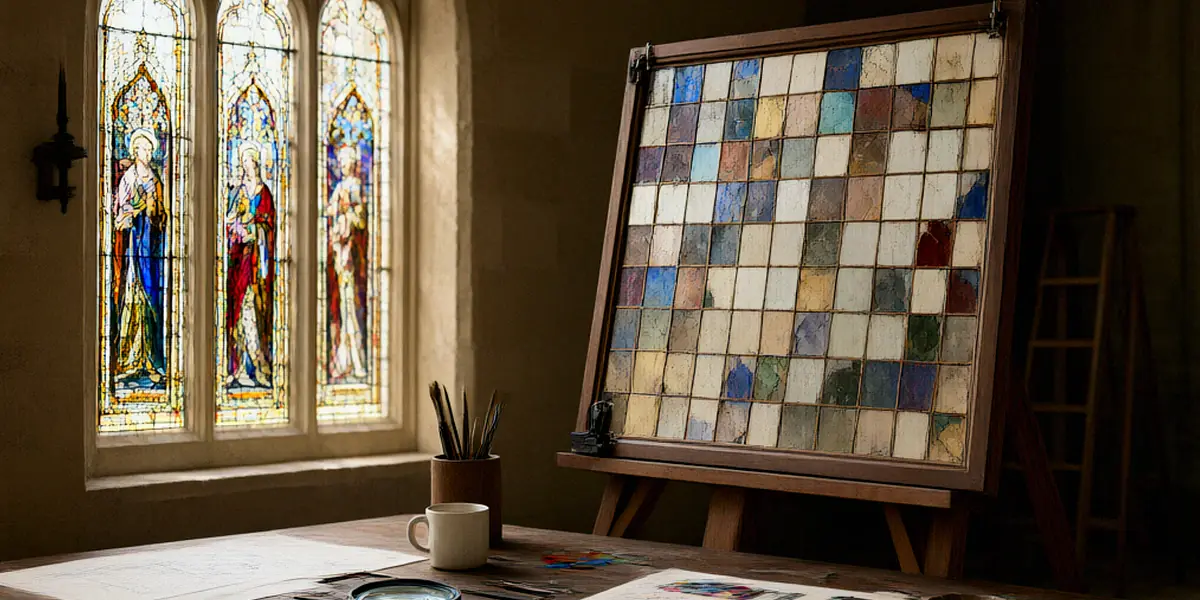
Medieval windows were narrative. A single window might tell the life of a saint across multiple panels, with donors kneeling at the base and inscriptions explaining the gift. The Reformation and later iconoclasm destroyed the majority of English medieval glass, so survivals are precious. Winchester Cathedral houses some of the finest medieval stained glass in England, and the windows at St Cross Hospital, just outside the city, are also remarkable. When you find medieval glass, look for small, richly coloured pieces, leaded in intricate patterns, often reassembled from fragments.
Victorian and Modern Glass: Revival and Innovation
After centuries of neglect, the nineteenth century saw a great revival. Victorian glass is often brighter and more sentimental than medieval work, with detailed narrative scenes and memorial inscriptions. Look for the maker’s name in the corner of a window — firms such as Clayton and Bell or Hardman were prolific. The twentieth century brought further innovation, with artists experimenting in abstract and figurative styles, particularly after the losses of the two world wars.
Symbols and Saints: A Visual Glossary
Learning a few symbols transforms how you read glass:
- Keys — St Peter
- A wheel — St Catherine
- A lily — the Virgin Mary or St Joseph
- A dragon beneath a knight — St George
- A lamb holding a banner — the Agnus Dei, Christ
Putting It All Together: A Practical Walkthrough
Reading a church is best done slowly and in a consistent order. Here is how we approach a visit.
Exterior Clues: Towers, Spires, and Porches
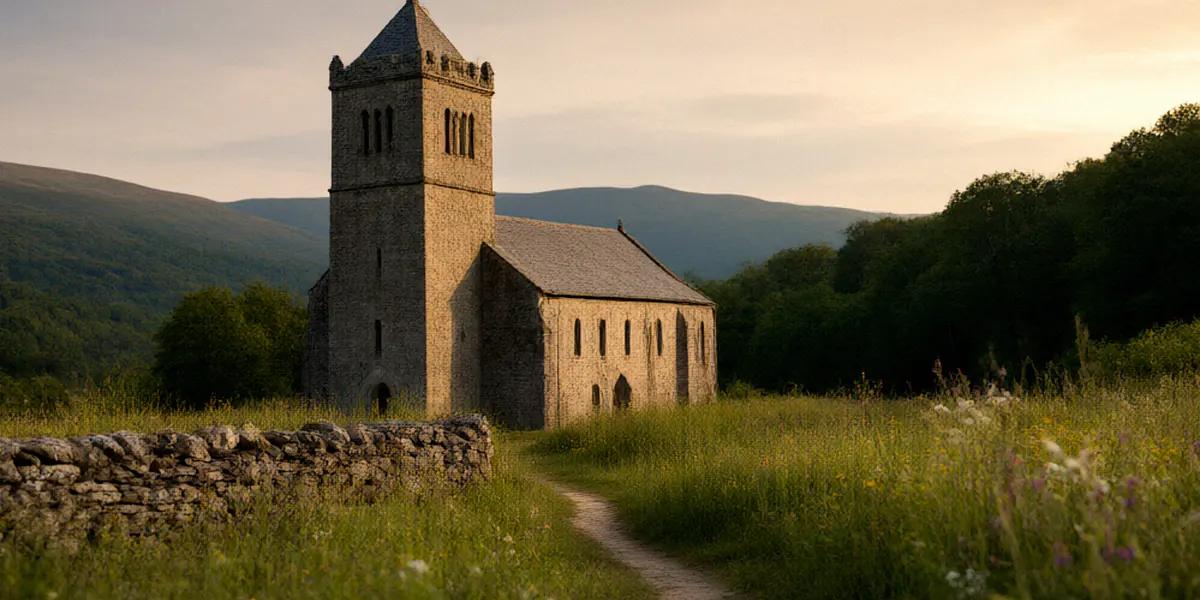
Begin outside. Walk around the whole building before going in. Note the tower or spire, the position of the porch (usually south), and the shape of the windows. A Saxon or Norman tower is often central; a later tower sits at the west end. Look for blocked doorways, changing stone colours and buttresses — all evidence of alteration. The porch itself may have a Norman doorway with carved capitals.
Interior Tour: Font, Nave, Chancel, and Beyond
Inside, follow a simple route:
- Start at the font, usually near the entrance, and check its age and carving.
- Walk the nave, noting wall paintings, monuments and window glass.
- Move into the chancel, looking for the sedilia, piscina and any surviving medieval paint.
- Explore side chapels, where family monuments and chantry foundations often survive.
- Look up at the roof — timbers, bosses and painted panels are easily missed.
In the Test Valley, two excellent starting points are St Mary’s, Andover, and St Peter’s, Stockbridge. Both repay careful looking, and both sit within easy reach of other rewarding churches.
Making Notes and Further Reading
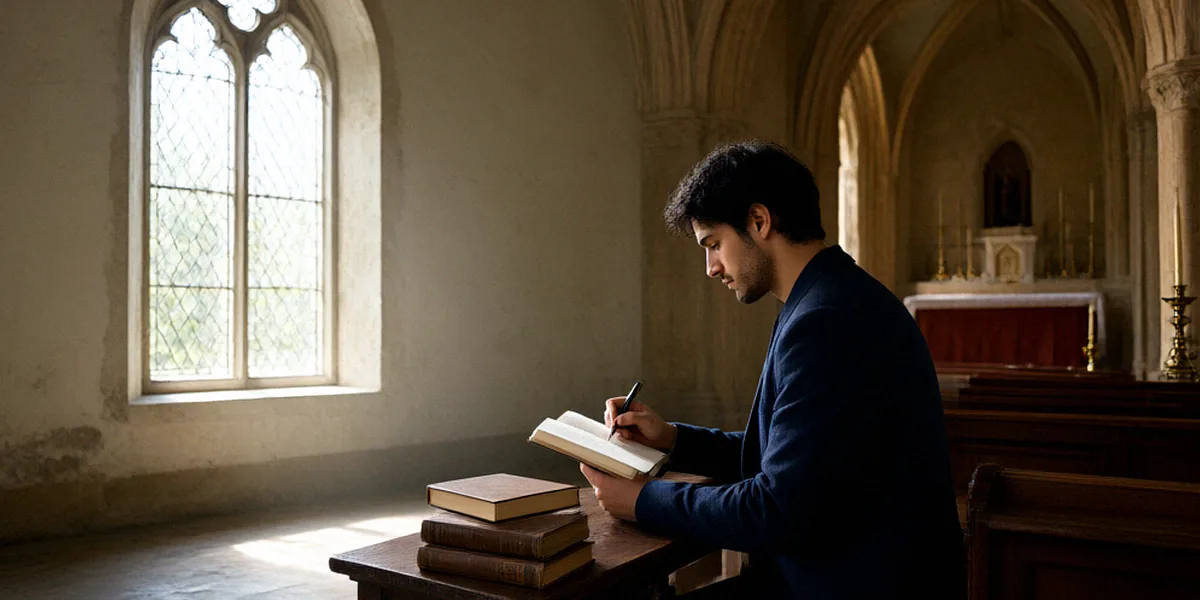
Bring a notebook and sketch what you see. Note dates from guidebooks, but question them — church guides are often outdated. Pevsner’s Buildings of England volume for Hampshire is indispensable, and local archaeological society records can add detail. Our blog exists to help you make sense of it all, with articles on individual churches, features and themes across the county.
FAQ
How old are Hampshire’s parish churches?
They span roughly a thousand years. Some, like St Mary’s, Breamore, contain Saxon work from before the Norman Conquest, while many others were founded in the Norman period or later medieval centuries. Most have been altered repeatedly since.
What should I look for first when I enter a church?
Start with the font, then the chancel arch, then the windows. These three features will quickly tell you the building’s age and its most significant phases of change.
Are medieval wall paintings common in Hampshire?
Survivals are relatively rare because most were whitewashed at the Reformation, but Hampshire has notable examples, including the Doom scene at St Mary’s, Ashley. Many more remain hidden beneath later plaster.
Where can I see good medieval stained glass in Hampshire?
Winchester Cathedral has some of the finest medieval stained glass in England, and St Cross Hospital nearby also preserves important glass. Many parish churches retain smaller medieval fragments.
Is the Test Valley good for church visiting?
Yes — it is one of the best areas in Hampshire for church crawling, with a dense cluster of medieval churches in villages along the river, including Stockbridge, Broughton and King’s Somborne.
Reading a parish church is a skill that grows with practice, and it deepens our appreciation of Hampshire’s extraordinary heritage. Every doorway, window and faded painting is a fragment of a story waiting to be pieced together. Next time you pass a village church, step inside, take your time, and see what you can read.

Post Comment